

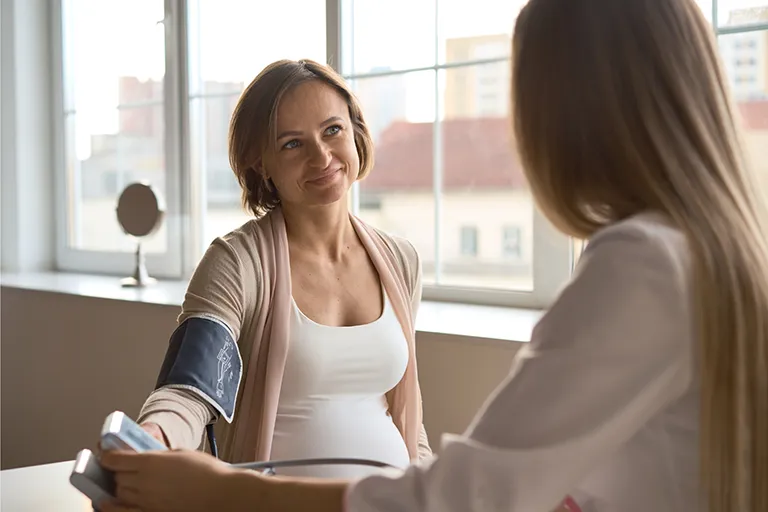
We don’t really know why some women develop preeclampsia in pregnancy and some do not. Preeclampsia is a disease of pregnancy. We can’t predict who will get preeclampsia. Being healthy does not decrease the risk for developing preeclampsia. Exercising doesn’t decrease the risk of preeclampsia. However, the current theory suggests developing preeclampsia is a two-phase process having to do with the way the placenta implants into the uterus. One of the big problems with preeclampsia is restricted blood volume. Ordinarily, increased circulating blood volume in your blood vessels (expansion) is needed for a healthy pregnancy. While we can’t predict who will develop preeclampsia, there are several risks to develop it, such as family history, occurrence in a previous pregnancy, chronic high blood pressure, high blood sugar, kidney disease, and autoimmune diseases such as lupus.
In the early and middle stages of preeclampsia, there are no symptoms. That’s why some people say eclampsia is surprising and unpredictable, although I find it to be neither. You don’t know you have it. That’s why we must pay attention to early signs like even a single high blood pressure reading. The signs of preeclampsia are a combination of elevated blood pressure, protein in your urine (indicating kidney failure), hyperreflexia (knee extends more than once with tapping), and laboratory signs of other organ failure. Severe preeclampsia symptoms include headaches, visual disturbances, and right upper quadrant pain associated with the liver. Symptoms can progress to eclampsia (which is preeclampsia with the addition of seizures) and lead to strokes, liver and kidney failure, and even paralysis or death.
In my experience, preeclampsia does not come on suddenly. Onset might seem sudden, but only if we ignore subtle symptoms. The first and most subtle sign of preeclampsia is a slightly elevated blood pressure. For example, if you have a blood pressure of 110/70 (normal) during your middle trimester, but it increases to 116/75, that’s a potential sign of preeclampsia.
I have learned that one elevated blood pressure is the first sign of preeclampsia. Sometimes high blood pressure does not progress to preeclampsia, but a slight increase in blood pressure is the first sign that preeclampsia can be developing. I have always recommended to my patients that they buy a blood pressure cuff so they can check their blood pressure twice daily at home. Recently, there’s been a lot of controversy about the accuracy of home blood pressure cuffs, but they are still useful for monitoring your blood pressure at home. The home blood pressure cuff may not read exactly the same as a cuff in your doctor’s office, but it is good for monitoring your blood pressure from one day to the next and indicating your pressure is rising. That’s what is important. If you aren’t already checking your blood pressure at home, do so twice a day. Call your doctor if your regular systolic or diastolic pressure goes up by ten points.
With the first sign of your blood pressure beginning to go up, I recommend modifying your activity. For example, if you’re working three 12-hour shifts I would recommend cutting back to four 8-hour shifts per week. If that doesn’t help, I would recommend cutting back more. Get enough sleep and rest. Don’t worry about housework. Have somebody else do it. Years ago pregnant women were often prescribed bedrest, but research has shown that bedrest can cause more problems than it solves. Bedrest is generally no longer recommended for pregnant women.
With even mild blood pressure elevations, I would recommend at least weekly visits to your doctor. Your doctor may give you aldomet, labetalol, or nifedipine to help control your blood pressure. All three medications are safe to take while pregnant. If your blood pressure isn’t controlled and the other symptoms of preeclampsia progress, delivery of your baby is the only treatment.
Preeclampsia is a pregnancy disease, but some of the worst cases of preeclampsia and eclampsia occur in the week or more after your baby is born. You should continue to monitor your blood pressure at home for a week after the birth of your baby. Your doctor should watch you and your blood pressure very closely for the week after you deliver your baby.


The KNOWHEN® Ovulation Test tracks your ovulation using only a drop of your saliva. It identifies your five (5) most fertile days and the best days in your ovulation cycle if you’re trying to conceive.